Agentic AI Platforms in 2026: Tool-Driven Architecture for Reliable Automation
A system-design playbook for agentic AI that moves beyond demos — with routing, RAG, guardrails, and observability that survive production load.
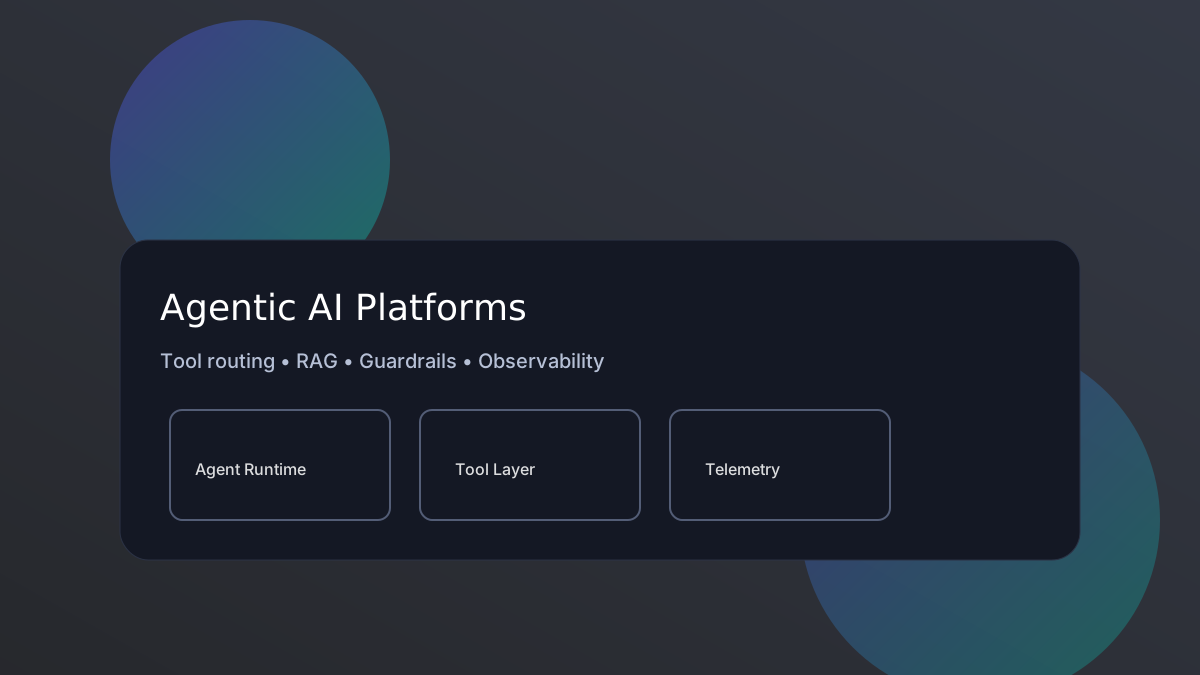
Why agentic systems break in production
As of April 2026, most agentic prototypes fail not because the model is weak, but because the system around it is brittle. Tool calls are unreliable, retrieval is noisy, and long-lived tasks drift without guardrails.
In 2026, the winning teams design agents like distributed systems: deterministic interfaces around probabilistic cores. That means strong contracts, structured outputs, and stateful execution paths instead of ad-hoc prompting.
Reference architecture (tool-first, retrieval-aware)
Think of the agent as an orchestrator that delegates to tools, data, and services. The model produces plans and structured tool calls; the platform executes, validates, and logs every step.

Key design decisions that matter
1) Retrieval quality beats larger context windows. RAG with strong chunking, embeddings, and freshness policies keeps hallucinations down and costs predictable.
2) Routing is a first-class service. Use a lightweight policy layer to decide when to call tools, when to ask for clarification, and when to stop.
- Use function-calling or tool schemas to constrain outputs and reduce parsing errors.
- Isolate tool execution in a sandbox and validate parameters before side effects.
- Cache retrieval and tool results at the task level to avoid repeated calls.
- Use step-level traces and budget policies (tokens, latency, cost) for every run.
Failure modes and guardrails
The most common production incidents come from uncontrolled tool chains: agents loop, call tools repeatedly, or execute the wrong action. Hard limits and state checkpoints are not optional.
- Deterministic retries: same input → same output → same tool calls.
- Explicit stop conditions and maximum hop counts.
- Human-in-the-loop gates for high-impact actions.
- Red-team prompts and offline simulations before release.
What to measure in 2026
Accuracy is not enough. Track task completion, tool success rate, retrieval precision, and cost per outcome. The best teams measure outcomes, not tokens.
- Task success rate by workflow.
- Tool call error rate and latency distribution.
- Retrieval precision/recall and freshness coverage.
- Cost per successful task and P95 latency.